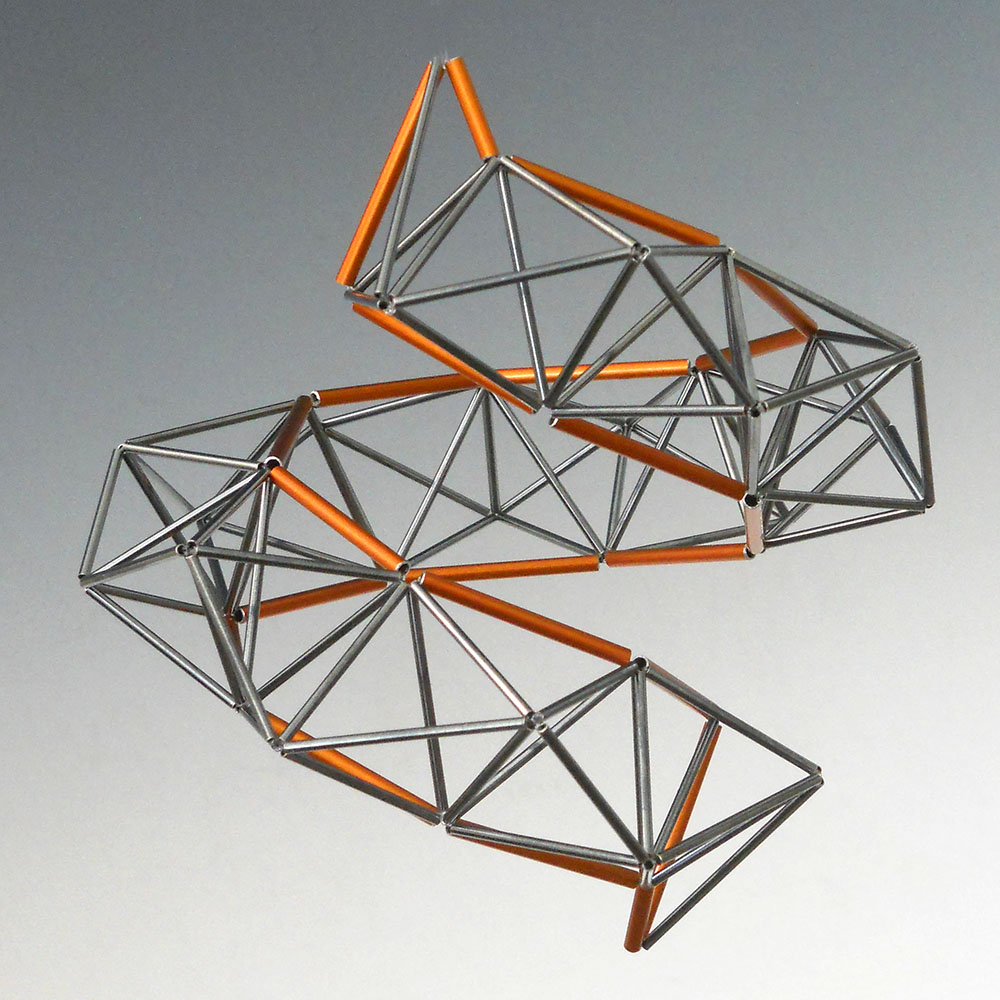
I thought I'd do a post of what I've been up to lately. Another piece where individual structures are interlinked to form a chain. For each link, I made an octahedron out of gold filled tubes, then added 8 long oxidized silver tubes to form another octahedron on the outside of it. It took a while to get it right because so many tubes were ending at the same place. Eventually I added a small round silver bead to separate the outer oct from the inner one, and that seemed to make it work.
The other thing I've been working on this summer is getting my work into galleries. I traveled around and talked to places, and I've gotten a few new ones, so if you're in any of these areas, I hope you'll stop by and take a look:
Albuquerque--Mariposa Gallery, 3500 Central Ave, mariposa-gallery.com
New Orleans--Ariodante Gallery, 535 Julia St, ariodantegallery.com
Chicago--Pistachios, 55 E Grand Ave, pistachiosonline.com
Hi--I'm a beadweaver located in Panama City, FL. Here I'm trying to put down where my ideas are headed, and what I'm working on creatively. You can see more of my work at emiliepritchard.com
Showing posts with label geometry. Show all posts
Wednesday, August 1, 2018
Saturday, June 2, 2018
new collar with gold
I love this piece! A few posts ago I talked about using some long beads on the outside of one of these collars and how it made the outside edge scallop. I had done it with stone and marble beads and didn't like the mix, but mentioned I might do it with gold tubes. Just finished this one and I really like it. I'm doing more these days with the gold (actually gold-filled) tubes as accents. and I think the contrast with the dark silver really works. For my own use, I mostly stick to the plain oxidized silver pieces, as they're less dressy, as is my lifestyle. But I do like making these silver and gold pieces. They tend to be simpler, and less funky, because when I piece has lots of different shapes and structures, then I think the contrasting color is distraction. But it makes a more classic piece pop.
By the way, after writing the earlier blog post about this structure, I forgot to read it before making this piece, and so had to redo it after getting around 1/3 of the way around. In the post the dark tubes were 28mm and the stone tubes on the outside edges were 20-35-20. In this one I started out using all 28s except for the long 35mm ones on the outside, so no 20s on the outside. That made the outside too long relative to the inside, so it curved was too tightly to fit your neck into it. So I changed the inside tubes to 31mm. It's still a pretty tight circle. If I wanted it a bit longer, instead of round, I'd make2 of the inside tubes in each side 35s instead of 31s. That would add a bit more length, but mostly it would make the curve shallower at that point. There are 12 inside tubes, so I'd change 3,4, 9 and 10. Actually I might just change 3 and 10 (talking to myself here) because you really want to do it when the line of the necklace is 90 degrees from the center point, so you're making it just longer, not wider.
Sunday, November 12, 2017
octahedra and pearls
Recently I bought some pearls with holes big enough to slide them over my tubes. I decided I wanted to make a neckpiece that was a simple series of octs, ornamented by the pearls. I had made a similar structure using bright silver and colored aluminum tubes a few years ago, and wanted to repeat that structure. So I went to my handy blog, where I keep track of my structures. Here's what I found, from August, 2014: "It's a simple chain of octahedrons. But a chain of octahedrons would normally form a straight line. In order to get the curve you need for a necklace I had to make the triangle on the outside edge longer than the triangle on the inside edge.
Here's where some trig would have come in handy in figuring out just how much longer, but I managed to figure it out with "lesser" math, and it came out right."
It would have been really handy if I had written down just what the lesser math had given me so that I could have reproduced the shape. That, after all, is one of the main reasons I write this blog. Since I didn't do that I started and ripped apart the new piece over and over trying to get the curve I wanted. As you can see I didn't get the same curve as last time; it's a little pointier at the bottom and straighter across at the back but I like it OK. It's also just a bit shorter. That's only because I was running out of 25 mm tubes, so I did just 20 octs instead of 22. Then I made the 2 tets at the back by the clasp longer. Also I now make my own hooks and they're longer than the one I used in the earlier piece. So the overall piece probably isn't that much shorter, but I do think it's a bit shorter.
So as not to make the same mistake twice I'll put down the plan for the curve. The outside triangles are mostly equilateral 25mm triangles. To get more curve I used 28/28/25 mm isosceles triangles at position 1 (at the center), 3, 9 and 10. On the inside the triangles are either 20mm equilateral or, at inits 1, 2, 3 and 6, to tighten the curve, 20/20/25 isosceles. It actually doesn't change things all that much. If I didn't want it to be so pointy at the bottom I could have spread them out more. Also triangle 6 is an equilateral 25mm oct. I CHANGED SOME OF THIS AND WROTE ABOUT IT IN THE NEXT POST.
Friday, September 8, 2017
new ideas for a tet structure

One thing I like about writing this blog is that it lets me memorialize ideas and structures that I might not use right away, but that I don't want to forget. I make notes, but a picture is truly worth a thousand words. Back when I worked with seed beads, and even round stone beads, I would keep structures that I had built but didn't plan to use any time soon. I have drawers full of "interesting" structures, an I'm sure many others of you do too. But the silver tubes are too expensive, both in the cost of the silver tubing and in the time it takes to cut, debur and oxidize them, to do that. So I'll be doing a couple of posts about ideas I've worked with that may or may not turn into something.
I'm finding that the tet (tetrahedron) structure that I've been playing with for a while has some new variations for me. I've learned now to think of it as 3 separate elements, as shown in the top picture. First, at the left of the picture, there's a row of triangles. Then I turn each of the triangles into a tet, in the middle of the picture. Finally I join the top points of the tets together with a zigzag line of tubes. Playing with the different elements affects different parts of the structure.
I've had the idea for a while that if the zigzag outer row alternated between long and short tubes, then the structure would spiral up or down instead of returning to its start like a donut. In pic 2 I turned that idea into a bracelet. This is a piece that I like a lot and will certainly keep and sell. I made 2 of them. The 1st was a tight spiral made by alternating between 28mm and 25mm beads in the outer row. All the rest of the tubes are 25mm. In this 2nd one I alternated between 28 and 22mm tubes, which made the spiral longer, and also made the overall bracelet diameter larger. As I have a small wrist I have a tendency to err on the side of bracelets that are pretty small, and I need to have a wider range.
The last picture is a potential necklace that I like quite a bit, but I did so much ripping and redoing that it has way too many threads hanging out, and I don't think I could ever make a firm enough piece out of it. More importantly, the idea was to put some contrasting color tubes in it to add interest. I used light green tubes, and they just don't show up enough. In the picture you can hardly see them. There's an area at the bottom left and a smaller one midway up the right side, But they barely show. Possibly my mistake was in only changing the color on the top layer of the area, instead of using all colored tubes there.But anyway, back to the structure. That length of the tubes in that outer zigzag row determines how tight the curve is. Longer tubes make for a tighter curve. If the outer tubes are somewhere around 2/3 the length of the other tubes (in a structure that's otherwise equilateral) the structure won't bend at all, but will continue in a straight line. Shorter that that and it curves inward. That means you can put that initial "belt" of triangles in the middle of the structure. Then you build tets on both the inside and the outside, and use short tubes to make a negative curve on the inside and long tubes for a positive curve on the outside. That was the initial idea, and it worked. The trouble and endless redoing came from making it curve and taper properly and also curve over your shoulder the way it should. I've been wanting to take it apart and reuse the tubes, and now that I have a good picture and notes, I won't forget it and I can rip it .
Wednesday, May 31, 2017
Design and color
I've been thinking design thoughts lately. Partly that's because one of the things I miss from my rugweaving days is working with color. And partly because I've started adding some gold to my pieces and the price dictates that I get maximum impact for the colored (i.e. gold) tubes I use.
First conclusion I've reached--always subject to change--Where a piece has a really interesting shape, and particularly an interesting outline, like the first piece shown, it works quite well in just oxidized silver. I could add areas of color if I wanted, but I don't have to. This would apply to my charm pieces as well. But where a piece is really regular some color helps to break things up, like in piece 2. And I tend to like having the color offset, not at the center of things.The next issue--placing the color. If I use a lot of colored tubes, I can do whatever I want and it will show well, but the problem arises when I don't want to use so many tubes. My regular and mathematical mind wants to use them to highlight the geometry I've spent so much time creating. But doing that usually means distributing a limited amount of color over the whole necklace, and sometimes it sort of loses it's impact. In the 3rd picture I have a piece where I think that spreading out the color really works. You just wouldn't see how the arms of the pinwheel spiral without those gold tubes indicating it. But more often I think that massing it, as I did in the piece with red tubes, is a better bet. I'd love to get others' opinions on this. What do you think?
Sunday, April 9, 2017
more right angle explorations
I haven't blogged in a while; sometimes life gets in the way. My husband and I have been in the sailboat business for 40 years, and we've just closed our store ( which was also my main studio) and are trying to figure out the future plan. I've now sold all my looms, and the jewelry work is quite portable, but it still creates complications. Right now I'm cutting tubes at a workbench in a storage locker we've rented, as we live in a townhouse, and the room I've set aside as my workplace is carpeted, and not conducive to sawing metal. My plan is to cut tubes in larger batches so that I don't mind going to the storage place to do it, but I'm also looking at the possibility of an outside workbench here that won't look too industrial and irritate the neighbors.
Meanwhile. though, I'm still playing with structures. I find the blog is a great way to keep a record of what I'm doing. I use my silver tubes to experiment, but it's too expensive to keep permanent structures made out of handcut and oxidized silver tubes just so that I can get ideas from them. So if I blog about them, then I have pictures and notes, and I can reuse the tubes for actual jewelry.
could serve as a hinge to join another structure. Actually, just as I write this and look at the pictures, I realize that this is really an octet truss, because if you left out the central tube that is the "hub" shared by 4 tets, you'd have an octahedron. Stay tuned!
I should mention that things don't always turn out that neatly. When I made a chain using only right triangle tets instead of alternating, nothing interesting happened. Also I suspect I could have found out the same thing just by creative use of the Pythagorean theorem, but then I wouldn't have pictures to remind me of what I'd learned.
Meanwhile. though, I'm still playing with structures. I find the blog is a great way to keep a record of what I'm doing. I use my silver tubes to experiment, but it's too expensive to keep permanent structures made out of handcut and oxidized silver tubes just so that I can get ideas from them. So if I blog about them, then I have pictures and notes, and I can reuse the tubes for actual jewelry.
Ever since I made thebracelet above, I've been fascinated by how an alternating series of right triangle tetrahedra and equilateral ones makes these square structures. I'm making a similar bracelet now, but I kept wondering if I couldn't make the series continue in a straight line instead of turning corners. (This happened at about the time I realized that I didn't have enough 20 mm tubes to finish the bracelet anyway.) So I tried it--and it works!
Doing it just the way I had done the square structures, i.e. alternating 1 right angle tet with 1 equilateral one, I got the top structure, which is flat on the bottom with a zigzag top. But what was more interesting, I thought, was that since the zigzag tubeson top were at fight angles to each other I could make them into right angle tets too and then (bottom picture) I get a structure with a square profile that I can extend as long as I want. Also if I end with an equilateral tet I have a tube at the end whichcould serve as a hinge to join another structure. Actually, just as I write this and look at the pictures, I realize that this is really an octet truss, because if you left out the central tube that is the "hub" shared by 4 tets, you'd have an octahedron. Stay tuned!
I should mention that things don't always turn out that neatly. When I made a chain using only right triangle tets instead of alternating, nothing interesting happened. Also I suspect I could have found out the same thing just by creative use of the Pythagorean theorem, but then I wouldn't have pictures to remind me of what I'd learned.
Saturday, December 10, 2016
New scaffold with gold
I've just finished a scaffold piece with accent tubes of 14 kt gold. Structurally it's similar to the one with blue and green accents below, with 2 exceptions. Both are based on chains of tetrahedrons. The sides are tetrahelices, but at the bottom I've massed larger groups of tetrahedrons. They're based on the idea that 5 tets that share a single center edge, like a hub, will form a circle. You can see such a group of 5 at the center bottom in each piece. Trouble is it doesn't actually work. For it to work exactly the angle between sides of a tet would have to be 72 degrees (I don't have a font that will write math symbols) so that 5 of them would add up to 360. But it's actually around 70.5 degrees. It would work if the hub tube were a little longer than the others. But when you start extending
the structure as I've done at the bottom of the piece you can't do that because a tube that is a hub in one group is a spoke or rim in other groups. So things don't quite work, and it gets worse the further you go. One of the reasons I've added small seed beads at the ends of each tube on the bottom piece is to add more "wiggle room".
But a while ago my favorite blog, (thebeadedmolecules.blogspot.com) showed a picture of the 8 possible convex deltahedrons ( ie convex shapes made exclusively from equilateral triangles) and one of them was essentially my 5 tet circle but without a hub tube at the center. That got me thinking, and in the new piece I left out some of the hubs where I could. Just leaving out 5 tubes made it fit together much better.
The other change I made was where the necklace curves around your neck at the back. You can take a tetrahelix and go off in a new direction that's about a 30 or 40 degree change (I've never measured it). I did 2 such jogs in the bottom piece to get to the clasp. It's fine, but I wasn't entirely happy with the sharpish corners that stick out. So in the new piece I made the tetrahelix curve by simply shortening the inside tubes, and it makes a smoother finish.
I'm really enjoying working with gold tubes. I think the contrast with the dark silver accentuates the geometry nicely. What I have to be careful about, though, is that the high cost of the gold tubing has a tendency to make me more conservative about what I make.Starting out, most of my gold pieces, like this one, are variations on designs that I already know I like. But if it works, I'm sure I'll get braver.
the structure as I've done at the bottom of the piece you can't do that because a tube that is a hub in one group is a spoke or rim in other groups. So things don't quite work, and it gets worse the further you go. One of the reasons I've added small seed beads at the ends of each tube on the bottom piece is to add more "wiggle room".
But a while ago my favorite blog, (thebeadedmolecules.blogspot.com) showed a picture of the 8 possible convex deltahedrons ( ie convex shapes made exclusively from equilateral triangles) and one of them was essentially my 5 tet circle but without a hub tube at the center. That got me thinking, and in the new piece I left out some of the hubs where I could. Just leaving out 5 tubes made it fit together much better.
The other change I made was where the necklace curves around your neck at the back. You can take a tetrahelix and go off in a new direction that's about a 30 or 40 degree change (I've never measured it). I did 2 such jogs in the bottom piece to get to the clasp. It's fine, but I wasn't entirely happy with the sharpish corners that stick out. So in the new piece I made the tetrahelix curve by simply shortening the inside tubes, and it makes a smoother finish.
I'm really enjoying working with gold tubes. I think the contrast with the dark silver accentuates the geometry nicely. What I have to be careful about, though, is that the high cost of the gold tubing has a tendency to make me more conservative about what I make.Starting out, most of my gold pieces, like this one, are variations on designs that I already know I like. But if it works, I'm sure I'll get braver.
Sunday, October 9, 2016
another redo
I didn't intend for these redos to become a "thing." But I did another one and I was so pleased with the results I decided to post it.
This was not a case of not liking the original piece; I actually liked it a lot. My intent when I made it was to use it as a jury shot, as it was rather big and dramatic. But I absolutely could not get it to photograph well (and I took a million pics). The top pic is the best I got, and the gold doesn't stand out against the black well at all. Also, photographing it straight on like that you don't get a good sense of the 3D-ness and it's hard to judge the size. So even though I liked the piece a lot, it wasn't doing what I wanted it to do.
That wouldn't have caused me to redo it, except for one thing. I realized after looking at it for a
while that it would have been more pinwheel-ish if I had put the arms that extend out right at the points of the hexagon that is the central structure of the necklace instead of in the middle of each face of the hex. Then it occurred to me that the best way to do it would have been to make a tetrahelix that would be part of the central part of the necklace and then continue into the extending arm. That would be a true pinwheel. And I rearranged the gold tubes to highlight the spiral better. Also I'm putting together an application for an exhibit of mathematical art and that would be a much purer mathematical structure.
So I redid it, and was quite pleased with the results.But that still left the photography problem. I took lots of pics, basically redoing all the mistakes I had made with the original necklace. Photographing it on the black form was the best way to get a sense of the size and dimensionality. But for some reason that I fail to understand, whenever I did that, even in the same room and under the same light conditions as the other shots, I got a picture that waymore washed out. Finally, I turned out all the lights, so I only had indirect light from the window, and dialed back the exposure to make it even darker--and it worked. I think it shows off the piece quite well. No idea why.
This was not a case of not liking the original piece; I actually liked it a lot. My intent when I made it was to use it as a jury shot, as it was rather big and dramatic. But I absolutely could not get it to photograph well (and I took a million pics). The top pic is the best I got, and the gold doesn't stand out against the black well at all. Also, photographing it straight on like that you don't get a good sense of the 3D-ness and it's hard to judge the size. So even though I liked the piece a lot, it wasn't doing what I wanted it to do.
That wouldn't have caused me to redo it, except for one thing. I realized after looking at it for a
while that it would have been more pinwheel-ish if I had put the arms that extend out right at the points of the hexagon that is the central structure of the necklace instead of in the middle of each face of the hex. Then it occurred to me that the best way to do it would have been to make a tetrahelix that would be part of the central part of the necklace and then continue into the extending arm. That would be a true pinwheel. And I rearranged the gold tubes to highlight the spiral better. Also I'm putting together an application for an exhibit of mathematical art and that would be a much purer mathematical structure.
So I redid it, and was quite pleased with the results.But that still left the photography problem. I took lots of pics, basically redoing all the mistakes I had made with the original necklace. Photographing it on the black form was the best way to get a sense of the size and dimensionality. But for some reason that I fail to understand, whenever I did that, even in the same room and under the same light conditions as the other shots, I got a picture that waymore washed out. Finally, I turned out all the lights, so I only had indirect light from the window, and dialed back the exposure to make it even darker--and it worked. I think it shows off the piece quite well. No idea why.
Saturday, June 11, 2016
Cubes
Ever since I figured out ( post in Sept., 2015) that I could make a rigid cube out of an octahedron and 2 tetrahedrons, by using right triangles instead of equilateral ones, I've been wanting to make a necklace like this. Not much to say about it, except that I really like it, and I wore it for the first time this week and got several compliments. I think I'll list it on etsy. I'm working on a similar one with 1 cube made from 14 kt gold tubes. I've been wanting to buy some gold tubing for a while now, and I've finally done it. It's not quite finished, but I love the contrast between the gold and the dark silver.
Sunday, March 27, 2016
building with tets
This is a continuation of an idea I talked about over a year ago ( Jan, 2015 to be exact). I've made several pieces that are chains of tetrahedrons. What I've learned is that instead of making 1 tet, adding the next and then the next, I can plan it better if I first make a chain of all the bases of the tets (far left in the first picture), then turn each base triangle into a tet (middle) then join the tets at the tops. The length of the tube that joins the tops will determine the curve of the structure. Here I thought of not using a tube to join the tops, but rather a string of beads. The length of the bead string determines the maximum curve, but within that limit the necklace can take the curve it wants. And the curving bead string gives the piece a ruffly look that I sort of like. The tighter the curve the piece takes, the less ruffly it will look. I assumed it would want to take a tighter curve at the bottom of the necklace than along the sides, so I added 1 bead to each chain for the links at the bottom to preserve the ruffliness.
As a side note, I have to say that this blog has turned out to be a help to me in keeping track of what I do. I've now had several occasions where I've had to reproduce something I've done before, or a variaton on it. I've never been too good at keeping records of what I do, but looking back at what I've blogger about has been a help. When I come up with a new idea, it seems interesting enough that I won't forget it, but 6 months down the road, I'm trying to remember what the actual lengths and arrangements of things were, and it's gone. Ah...age.
Saturday, December 12, 2015
more geometry games
Back in September, I wrote about using right triangles in building tetrahedrons and octahedrons, and how really interesting things happened. Mostly I was using 20mm tubes as the sides of my right triangles and 25mm tubes with #11 seed beads at each end as the hypotenuses. Effectively, that made the hypotenuses 28mm. That worked because to have a right triangle where the 2 sides are equal, the length of the hypotenuse has to equal the side times the square root of 2 (I wish I had a font with a square root sign in it). So for a 20 mm side you need a roughly 28mm hypotenuse. I had been cutting my tubes in lengths of 10, 15, 20, and 25mm lengths. But it occurred to me that if I changed from cutting 15mm tubes to cutting 14mm instead, and added a 28mm length, then each length (except the 25mm) would be a hypotenuse length for the size below it, i.e. I could make right triangles with sides of 10 mm and a 14mm hypotenuse, or 14mm sides with a 20mm hypotenuse, or 20mm with a 28mm one. I kept the 25mm size too because it's roughly an inch and sometimes my non-scientifically minded brain just reverts to inches.Anyway that led to lots of playing around with right triangles. And here's another place where cool things happened. I've made several bracelets out of chains of tetrahedrons. As you can see
from the first picture it's not a perfect fit. There's a repeating 4-tet unit, and six of them, pictured here, don't quite come together. You can pull them together as in picture 2, where there's a hexagon at the center of the circle. Or, depending on the length you want, you can force them apart a bit and make the circle out of 7 units with a heptagon in the middle. I think in my bracelets I've actually pushed them apart enough to use 8 units to make the circle big enough to fit over the wrist.
But anyway, for purposes of this exercise I was acting as if 6 units made a circle. But then I tried substituting one size longer tubes on some of the outside edges to make the structure curve faster. In picture 3, I alternated 2 units made all of 14mm tubes with 2 units made of 14mm tubes but with 20 mm tubes on the outside. I had no idea I'd get anything regular, but it turned out that I got a circle made of 4 units (16 tets). The figure at the center is a square on one side, the bottom in picture 3, and a diamond on the other, top, side. And if I made all the outside edges 20mm and all the others 14mm ( last picture) I got a circle with 3 units.
My favorite of these shapes is the 4-unte one, especially because the front and back are different. I'd like to make a piece using these and using some colored tubes to highlight the patterns on front and back. Stay tuned.
Wednesday, November 4, 2015
Necklace "upgrade"
Back in April I did a post about playing with octahedra that had a square shape, i.e. that had 2 sides, in front and back that were basically squares with a long edge forming a hypotenuse. I showed this piece, with the colored tubes acting as the hypotenuses. I liked the piece because of the color, and because I liked the squar-ish shapes, but over time I came to think it was just a bit boring. My work tends to be pretty minimalist, and I like that clean, simple look, but sometimes it's hard to find the line between simple and boring.
I kept looking at the piece, and finally decided it needed a change. I wanted to break up the symmetry just a bit. Actually all I did was add 5 more octs to the red section in the middle, but I thought it made the necklace a lot more
interesting. And I guess I was proved right because I sent it to a sort of trunk show that I participate in, and it sold the first day.
With that piece gone, I'm working on another one using the square octs with colored aluminum hypotenuses. If it works out I'll post it when it's finished.
I kept looking at the piece, and finally decided it needed a change. I wanted to break up the symmetry just a bit. Actually all I did was add 5 more octs to the red section in the middle, but I thought it made the necklace a lot more
interesting. And I guess I was proved right because I sent it to a sort of trunk show that I participate in, and it sold the first day.
With that piece gone, I'm working on another one using the square octs with colored aluminum hypotenuses. If it works out I'll post it when it's finished.
Monday, September 21, 2015
Math is SO COOL
I had such fun playing with beads/math today. The other day I was looking at something that was showcasing geometric jewelry. I'd tell you the source, except that I totally can't find it any more, and I don't know whose work it was that got me started on this. But anyway, I saw some jewelry that had painted cubes in it. The cubes faces were 2 colors, with the color change happening on the diagonal of the square. The way the colors were arranged, you could see that cubes have tetrahedrons embedded in them, but tets that use right triangles instead of equilateral ones. So I started playing around. I was using 20mm tubes for the sides of the cubes, so for a hypotenuse I needed around 28 mm. I used 25mm tubes with a #11 seed bead on either end, and that worked pretty well. Turns out that you do that and make an octahedron with a tet at either end. That's a structure that I've used over and over, but not with right triangles. When you make either equilateral triangles, of just irregular triangles, you get things like this:
But if you do it with right triangles, you get this: a cube. How cool is that?
I hope you can see it; it's hard to photograph 3D stuff like this. There's a tet at the top and another at the bottom of the picture. In between is an oct with hypotenuse edges at top and bottom and side length edges zigzagging around the middle.
In that cube some of the diagonals line up end to end and some don't. I realized that I could make them all go line up end to end, and I wondered what the internal structure of a cube like that would be. I guessed that it might be 5 tets, but I couldn't envision it. The reason I guessed that it might be 5 tets if that I've learned that when you make an oct, at the time when you've put in 11 of the 12 tubes, and you're getting ready to add the 12th tube, there are 2 possible ways you can orient the 12th tube. One produces an octahedron and the other produces a cluster of 3 tets. So I guessed that it would be possible to make a cube out of 5 tets.
Voila! It turns out that there's an internal equilateral tet made of all hypotenuses. Then each of the 4 faces of that tet is the base for a tet made of sides of the cube.
You might say this is interesting, but so what. But for me it could be big. I really like building things using RAW, but I couldn't use it with the tubes, because the square sides weren't rigid. Everything could collapse. So I had to work with tets and octs. But right angles are so much more intuitive. We've been stacking blocks since we were kids, and we know how to assemble things using right angles. 60 degree angles and equilateral triangles are much wierder. So now I can use structures that work with tubes, but still build cubes. At the moment the cubes I've made are pretty big, but who knows where this will lead?
Wednesday, September 2, 2015
Engineering a piece
I thought I'd post something about the way I design a piece, which is a very slow, trial-and error process. I've been doing more with my idea of a structure that goes back and forth between the hex-based structures for round beads and the triangle-based tube structures. I've done several along the lines of the one in my last post, where the necklace is a chain of polyhedrons, going back and forth from stone shapes to tube ones. Here I wanted to vary that a bit, and create individual "links" that combined tubes and stone, and then join them together. I started by creating the stone shape (what you see is actually the 3rd version). At each end it has a triangle of 3 10mm tubes and that becomes the base for a tube octagon. The problem, then, was to join the 2 octs together to form a round shape and then link those shapes together. You can't join them with an octahedron, because in those the triangles on opposite sides point in opposite directions, whereas these both have their point on the bottom. You could use a chain of 2 octs, but that would entail lots of short tubes, and I didn't think that was what I wanted. So I simply joined them with 3 parallel tubes at the top ( that's the one on the left). But all those parallels, as I should have known, allow lots of wobble--rectangles becoming parallelograms, etc. In the one on the right I added 2 more parallels down at the bottom of the tube part, but still had the same problem.
After some screwing around I realized that there was a way to make the structure out of 3 tube octahedrons. If I changed the shape of the ones coming off of the stone form so that they touched each other, then you could have an oct in the middle because you wouldn't be attaching to triangles on opposite ends of it, but to triangles that meet at a vertex. It makes the "donut hole" smaller than I wanted, but that's what I ended up with. I think you can see that I've taken advantage of the flexibility in the stone part of the link. The stone structures in the top and bottom pictures are the same, but in the bottom one they look longer and shallower than in the top one.
Another issue is color. I think it dates back to my rugweaving days, but I always tend to think that if 1 version of a color is good than 5 are that much better. That is, If I'm using green stones, I want each iteration to use a different green. In designing these stone-and-tube pieces, I've so far fought that urge. For one thing, I think a piece looks less formal when it uses several colors than when all the stones "match." Also I'm beginning to think that just because a piece of jewelry is necessarily small, at least compared to a rug, more cohesiveness might be good. However, in this piece, just because the color brown is itself so neutral, I went back to my old ways and used several browns and brown-reds.
After some screwing around I realized that there was a way to make the structure out of 3 tube octahedrons. If I changed the shape of the ones coming off of the stone form so that they touched each other, then you could have an oct in the middle because you wouldn't be attaching to triangles on opposite ends of it, but to triangles that meet at a vertex. It makes the "donut hole" smaller than I wanted, but that's what I ended up with. I think you can see that I've taken advantage of the flexibility in the stone part of the link. The stone structures in the top and bottom pictures are the same, but in the bottom one they look longer and shallower than in the top one.
Another issue is color. I think it dates back to my rugweaving days, but I always tend to think that if 1 version of a color is good than 5 are that much better. That is, If I'm using green stones, I want each iteration to use a different green. In designing these stone-and-tube pieces, I've so far fought that urge. For one thing, I think a piece looks less formal when it uses several colors than when all the stones "match." Also I'm beginning to think that just because a piece of jewelry is necessarily small, at least compared to a rug, more cohesiveness might be good. However, in this piece, just because the color brown is itself so neutral, I went back to my old ways and used several browns and brown-reds.
Monday, August 17, 2015
Combined structures
I've been thinking about the fact that I've been working with 2 different structures lately. With the round gemstone beads I work with a system based on hexagons that is the outgrowth of what I learned from the Beaded Molecules blog. Then I have another set of shapes based on triangles that I use with the silver tube beads. I really like the openness of the tube structures, but it occurred to me that I could accentuate the not-there-ness of the tubes by having areas of more there-ness using gemstone beads. I've done that in several pieces by having structures of gemstones and having them interlock with other structures, made of tubes. I've liked that, but I wanted to find a way to integrate them into a single structure that goes from tubes in triangles to stone beads in 6 bead circles (functionally hexagons) and back again. This does that, and I think I'll do more along this line.
I've also been playing around with photography again. This picture was done by hanging the necklace (with loops of monofilament line that I can then photoshop out) from a hoop of steel cable with the background behind it but not touching it. Here it's close enough that you still see the shadow of the piece on the background. Can't decide if I like that. I did it again with the background farther away, and that may be better. I hadn't actually planned on putting that picture in the blog, but now that I've mentioned it I guess I will. It's a more dramatic
picture, but for some reason I couldn't get it so that you could see the light aqua of the beads very well. I think I need more light.
I've also been playing around with photography again. This picture was done by hanging the necklace (with loops of monofilament line that I can then photoshop out) from a hoop of steel cable with the background behind it but not touching it. Here it's close enough that you still see the shadow of the piece on the background. Can't decide if I like that. I did it again with the background farther away, and that may be better. I hadn't actually planned on putting that picture in the blog, but now that I've mentioned it I guess I will. It's a more dramatic picture, but for some reason I couldn't get it so that you could see the light aqua of the beads very well. I think I need more light.
Labels:
design,
gemstone beads,
geometry,
hexagon,
photography,
triangle,
tube
Saturday, July 18, 2015
stars
On my recent boat trip, I was playing around with some new ideas. One of them was stellations. I made an ornament by making an icosahedron and stellating it by turning each triangle into a tetrahedron. I liked it, but as it was almost 3" in diameter it wasn't very practical as jewelry. Then something occurred to me. The icosahedron at the center of it was made up of groups of 5 triangles that formed pentagons coming to a point at the center. If I took one of those groups of triangles, and made it point inward instead of outward, I'd have a flat side that could lay against the body. Then I could stellate all the rest of the triangles. Voila! Of course, these star forms still extend out quite a ways from the body, but I kind of like that. I also made a few where the 5 tetrahedrons at the center of the star are made from shorter tubes, and so don't stick out so far, but for the big necklace I decided to stick with the long tubes.
Thursday, January 29, 2015
Octahedron shapes.
I've been playing around with the different shapes I can get in octahedrons. I started thinking about how I don't get a firm shape using RAW with tube beads because a square isn't rigid the way a triangle is. But on the other hand right angles are just so "freindly" to work with. We're surrounded by them, and we know how they work. So I started imagining octahedrons (octs)that were more or less square in overall shape. I wanted the piece to be not too deep, i.e. not sticking up too far off the body (as lots of my pieces do). So with a relatively flat oct I could just use Pythagorus to figure out how long to make the "waist" beads--here the gold beads-- so that you'd have a right triangle, and that would make a square shaped oct. The cross-wise and length-wise tubes are 20mm long, so a 28mm gold tube would be about right. Actually, though, I decided to use 25mm cold tubes instead, so the octs aren't quite square, but zigzag a bit. Partly that was because I thought a bit of a zigzag was more interesting, and partly because I prefer using more or less stock lengths rather than cutting tubes just for a single design. If I use stock lengths (5, 10, 15, 20 and 25mm), I have more flexibility in the design. If I cut custom pieces ahead of time, I have to have it all figured out before I do it, and I like to sort of make it up as I go along, even if I have the general idea figured out at the start. Also there would be lots of times that I would cut lots of, say 28mm tubes and then discover that to get the right curve, I really needed them to be 27.5 or 29mm or whatever.
Here, when I got to the back and needed to make it curve, I had to use shorter tubes on the inside triangles than on the outside ones. The ideal length for the inside tubes would have been around 18mm, so I just alternated between 15mm tubes in 1 oct and 20mm ones in the next. One of these days I'd like to skip the curve and do a piece that would look sort of like a tic-tac-toe grid.
Thursday, January 1, 2015
dangles redone; learning about structures
Well, I redid my dangles, as I mentioned in my last post, and they do indeed dangle more freely now.
The thing I probably should have talked more about concerning this necklace is the tube itself. It took several tries to get it right. The nice thing about doing more random structures is that when you need it to curve, you can just start throwing in a few short tubes on one side and longer ones on the other side till you get the amount of curve you need, But with a piece like this, where you keep repeating a structural shape, you have to get the shape right so that it will produce the curve you need. My initial plan was that my tube would be octahedrons ( I call them octahedrons because they're made of 8 triangles, but, of course, they're not equilateral triangles as they would be in a true octahedron). The cross-section triangle would be all short (15mm) tubes . The tubes running more or less lengthwise would be 20 mm, except that to get the curve I wanted the triangle on the outside would have 25mm tubes. I'm trying to use tubes of 5, 10, 15, 20 and 25 mm and make that work without cutting special lengths for a particular piece. Anyway, it didn't work--the curve was too tight. I tried 2 more variations before I came up with this one, where the cross-sectional triangle alternates between a 15mm equilateral one and an isosceles one. That made a curve that was just a bit too shallow, but I had a few longer tubes (28-ish mm) so I could put them in the 2 outside triangles at the very center, i.e. bottom of the necklace and get a sharper curve just there.
This brings up a whole new idea--that I have to move from thinking of a piece as a chain of units, and think more about the overall piece as a unit. I came up against this same issue some years ago in a sphere I made and posted about at the very start of this blog. My idea was to take the basic dodecahedron ( Plato bead in
some publications) and think of it as a bead to use in building a bigger sphere, a truncated icosahedron ( or Archimedes bead). That's what I did here (sort of--Actually there are 60 small spheres, not 90, but anyway...). I built it adding on 1 sphere after another, and when I got to the last 4 or 5 spheres it was really hard to get the needle in and out as the big sphere closed up. After I was done I realized it would have gone much easier if after I had gotten, say, 2/3 done I had switched my viewpoint to the whole sphere. Then I could have built the whole inside of the rest of the sphere, the very dark blue beads, then the whole middle layer, the clear beads, and finished with the outer cobalt blue layer.
Now I'm have the same issue with my tube necklaces. Here's one in particular. I've been using a chain of tetrahedrons to make either a bracelet or a necklace. Mostly the only way I could make the structure go from making a bracelet to making a necklace was to make all the tetrahedrons bigger.
Finally, you have the zigzagging tubes on the outside edge of the curve. Here I have just 2 bright silver ones on the far right. It turns out that the length of these tubes determines the shape of the curve. Here I've used tubes that are shorter than the other ones. By using shorter tubes (20mm instead of 30mm) you almost eliminate the curve in the structure. The longer the tube the tighter the curve. So now I understand the structure and will have much more control over what I build with it.
This has been pretty windy, but spelling it out helps me get it into my head, so if you've gotten this far, my apologies for the length. Also the paragraphing got real weird at the end and I don't have the energy to go back and fix it. Happy New Year.
The thing I probably should have talked more about concerning this necklace is the tube itself. It took several tries to get it right. The nice thing about doing more random structures is that when you need it to curve, you can just start throwing in a few short tubes on one side and longer ones on the other side till you get the amount of curve you need, But with a piece like this, where you keep repeating a structural shape, you have to get the shape right so that it will produce the curve you need. My initial plan was that my tube would be octahedrons ( I call them octahedrons because they're made of 8 triangles, but, of course, they're not equilateral triangles as they would be in a true octahedron). The cross-section triangle would be all short (15mm) tubes . The tubes running more or less lengthwise would be 20 mm, except that to get the curve I wanted the triangle on the outside would have 25mm tubes. I'm trying to use tubes of 5, 10, 15, 20 and 25 mm and make that work without cutting special lengths for a particular piece. Anyway, it didn't work--the curve was too tight. I tried 2 more variations before I came up with this one, where the cross-sectional triangle alternates between a 15mm equilateral one and an isosceles one. That made a curve that was just a bit too shallow, but I had a few longer tubes (28-ish mm) so I could put them in the 2 outside triangles at the very center, i.e. bottom of the necklace and get a sharper curve just there.
This brings up a whole new idea--that I have to move from thinking of a piece as a chain of units, and think more about the overall piece as a unit. I came up against this same issue some years ago in a sphere I made and posted about at the very start of this blog. My idea was to take the basic dodecahedron ( Plato bead in
some publications) and think of it as a bead to use in building a bigger sphere, a truncated icosahedron ( or Archimedes bead). That's what I did here (sort of--Actually there are 60 small spheres, not 90, but anyway...). I built it adding on 1 sphere after another, and when I got to the last 4 or 5 spheres it was really hard to get the needle in and out as the big sphere closed up. After I was done I realized it would have gone much easier if after I had gotten, say, 2/3 done I had switched my viewpoint to the whole sphere. Then I could have built the whole inside of the rest of the sphere, the very dark blue beads, then the whole middle layer, the clear beads, and finished with the outer cobalt blue layer.
Now I'm have the same issue with my tube necklaces. Here's one in particular. I've been using a chain of tetrahedrons to make either a bracelet or a necklace. Mostly the only way I could make the structure go from making a bracelet to making a necklace was to make all the tetrahedrons bigger.
But then I rethought, and realized there are sort of 3 parts to the structure. The last picture shows it (I hope) with bugle beads. First there's a series of triangles at the top of the structure, which will be the inside of the curve.
In this example they're a sort of light iridescent gray, and you can see them by themselves on the left. By playing with the size of these triangles you can vary the height of the piece. I have tended so far to make it tall and sort of dog collar-ish. Then there are the tubes (here dark gray and spirally) that turn those original triangles into tetrahedrons, so that the dog collar becomes a spiked dog collar, as in the center. Actually you could leave the piece like this, and one of these days I probably will. 
Finally, you have the zigzagging tubes on the outside edge of the curve. Here I have just 2 bright silver ones on the far right. It turns out that the length of these tubes determines the shape of the curve. Here I've used tubes that are shorter than the other ones. By using shorter tubes (20mm instead of 30mm) you almost eliminate the curve in the structure. The longer the tube the tighter the curve. So now I understand the structure and will have much more control over what I build with it.
This has been pretty windy, but spelling it out helps me get it into my head, so if you've gotten this far, my apologies for the length. Also the paragraphing got real weird at the end and I don't have the energy to go back and fix it. Happy New Year.
Sunday, October 19, 2014
More tetrahedrons
I'm playing with tetrahedrons again. I'm discovering that being able to cut my own tubes is changing my mindset. When you work with beads mostly you're saying "what can I do with the beads I have?" When you can make your own you start to ask "What beads ( or in this case lengths of beads) will do what I want to do?" I came up with a sequence of tetrahedrons that would produce a very gentle curve. But by lengthening the tube on the outside of the curve you can make the curve sharper. But how much to lengthen it? I did what I could with math--Pythagorean theorem and all that. But that doesn't completely do it because there's always some looseness in beadwork, and errors build up. I had
decided I wanted to do a necklace that would go over your head without needing a clasp, but I didn't want it to be too huge either. And the tubing is expensive enough that I can't just keep trying different lengths till I get what I want.
I played around with coffee stirrer straws (top picture), using 50mm straws for 25mm tubes, 40mm straws for 20mm tubes etc, and could approximate things that way. For the most part I'd like to stick with cutting my metal tubes in lengths of 5, 10, 15, 20mm etc. Otherwise it's just too hard to keep track of things. But for a given piece I can always pick one element (like the tube on the very outside) and make it whatever I need to make the shape come out right. Anyway, I'm still learning, still having fun.
decided I wanted to do a necklace that would go over your head without needing a clasp, but I didn't want it to be too huge either. And the tubing is expensive enough that I can't just keep trying different lengths till I get what I want.
I played around with coffee stirrer straws (top picture), using 50mm straws for 25mm tubes, 40mm straws for 20mm tubes etc, and could approximate things that way. For the most part I'd like to stick with cutting my metal tubes in lengths of 5, 10, 15, 20mm etc. Otherwise it's just too hard to keep track of things. But for a given piece I can always pick one element (like the tube on the very outside) and make it whatever I need to make the shape come out right. Anyway, I'm still learning, still having fun.
Thursday, September 11, 2014
Tetrahedrons
It turns out I said something wrong in an earlier post. I said that tetrahedrons would tile in space, i.e. fill up 3 dimensional space completely the same way cubes can. Turns out that's wrong. If wikipedia is correct, though, I'm in good company in my error, because they say that Aristotle believed it too.
It starts out with the idea that 5 tetrahedrons will make a pentagonal solid like the one pictured here. Actually it's close enough that it works fine in beadwork, but as an actual matter of geometry the 5 tets would leave just a few degrees left in the circle. Knowing that, I was aware, as I made this piece, that I had to tug just a bit extra to get the fifth tetrahedron to close. Never noticed that before.
If the 5 tets did actually make the figure they seem to make, then 20 tets would fill an icosahedron, and you could keep adding on tets forever to fill space. close, but no cigar.
This probably has very little relevance in actual beadwork, since, as I said, it's close enough that you can pretty much make it work, but I had to mention it.
It starts out with the idea that 5 tetrahedrons will make a pentagonal solid like the one pictured here. Actually it's close enough that it works fine in beadwork, but as an actual matter of geometry the 5 tets would leave just a few degrees left in the circle. Knowing that, I was aware, as I made this piece, that I had to tug just a bit extra to get the fifth tetrahedron to close. Never noticed that before.
If the 5 tets did actually make the figure they seem to make, then 20 tets would fill an icosahedron, and you could keep adding on tets forever to fill space. close, but no cigar.
This probably has very little relevance in actual beadwork, since, as I said, it's close enough that you can pretty much make it work, but I had to mention it.
Subscribe to:
Posts (Atom)